WORKED EXAMPLES
Start hereHow a junction is calculated, step by step
The whole route on one detail: importing the CAD drawing, assigning materials and boundary conditions, resolving the air space, refining the mesh until the answer stops moving, and reading the result. Every figure comes from the run that produced the box lintel example below.
Timber-frame box lintel over an opening
A modern insulated box lintel in a timber-frame wall, drawn in CAD and calculated in Psiclops exactly as you would calculate your own. The detail depends on a second model: the insulated I-joist bay above it is a 2D assembly in its own right, solved separately for an equivalent conductivity and then referenced as a material — both appear below, as they would in a real report. SAP Table K1 assigns this junction type (E2) a default ψ-value of 1.000 W/(m·K) unless a bespoke calculation is provided; the calculated value is around 96% better than that default.
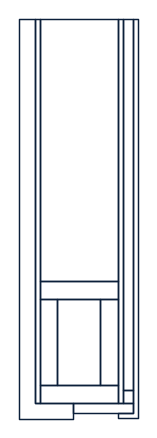
Drawn detail — timber frame box lintel (SAP Table K1 E2), with a referenced I-joist bay assembly
View full report →Timber-frame external corner with an I-joist bay
An external corner in the same timber-frame construction, and a good illustration of why a corner is worth modelling rather than defaulting: the two flanking walls each reach the same U-value, and the corner itself adds very little. It uses the same I-joist bay assembly as the box lintel, and carries a 25mm cavity that turns the corner — a shape whose real thickness matters, and which Psiclops measures rather than infers from a bounding box. Against SAP Table K1's E16 default of 0.180 W/(m·K), the calculated value is around 78% better.
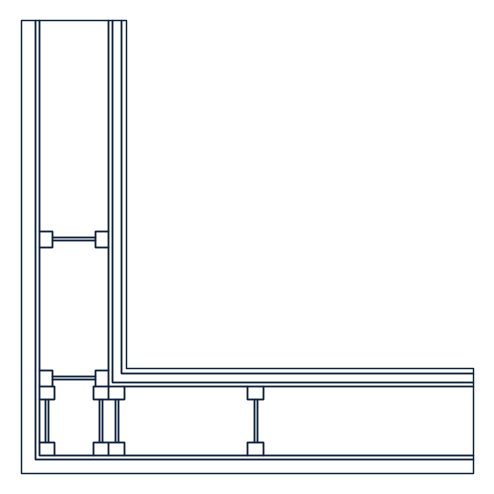
Drawn detail — timber frame external corner (SAP Table K1 E16), with a referenced I-joist bay assembly
View full report →Steel lintel with perforated base-plate (BR 497 Worked Example 3)
A real, published BR 497 worked example: a steel box lintel with a perforated steel base-plate, bridging the cavity above an opening in a standard UK masonry cavity wall. Modelled here from BR 497's own published construction, dimensions, and boundary conditions (Figures B3a/B3b/B3c, Tables B3a/B3b), using Psiclops's own FEM engine — the computed ψ-value and fRsi below can be checked directly against BR 497's own declared values for this exact example.
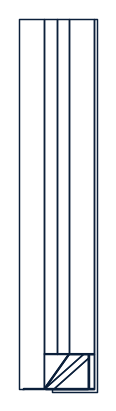
BR 497, Appendix B, Worked Example 3 (E1 — Steel lintel with perforated steel base-plate)
View full report →